Perplexity as an AI safety threshold: a good thermometer, not yet a thermostat
When we teach cross-entropy to engineering students, we start with Shannon. The better you predict a source, the fewer bits you need to encode it.
On November 22, OpenAI’s chief scientist Jakub Pachocki proposed the same quantity as a shared threshold for AI safety. OpenAI also published its internal pretraining curve for the first time. On the company’s own internal code dataset, the reported log-perplexity values are:
- GPT-3.5: about 0.99
- GPT-4: about 0.91
- Below 0.8: a marked jump in cybersecurity and mathematics capabilities
- About 0.76: first solutions to open math problems OpenAI had posed to its models for over a year
- Next expected window: 0.68–0.70
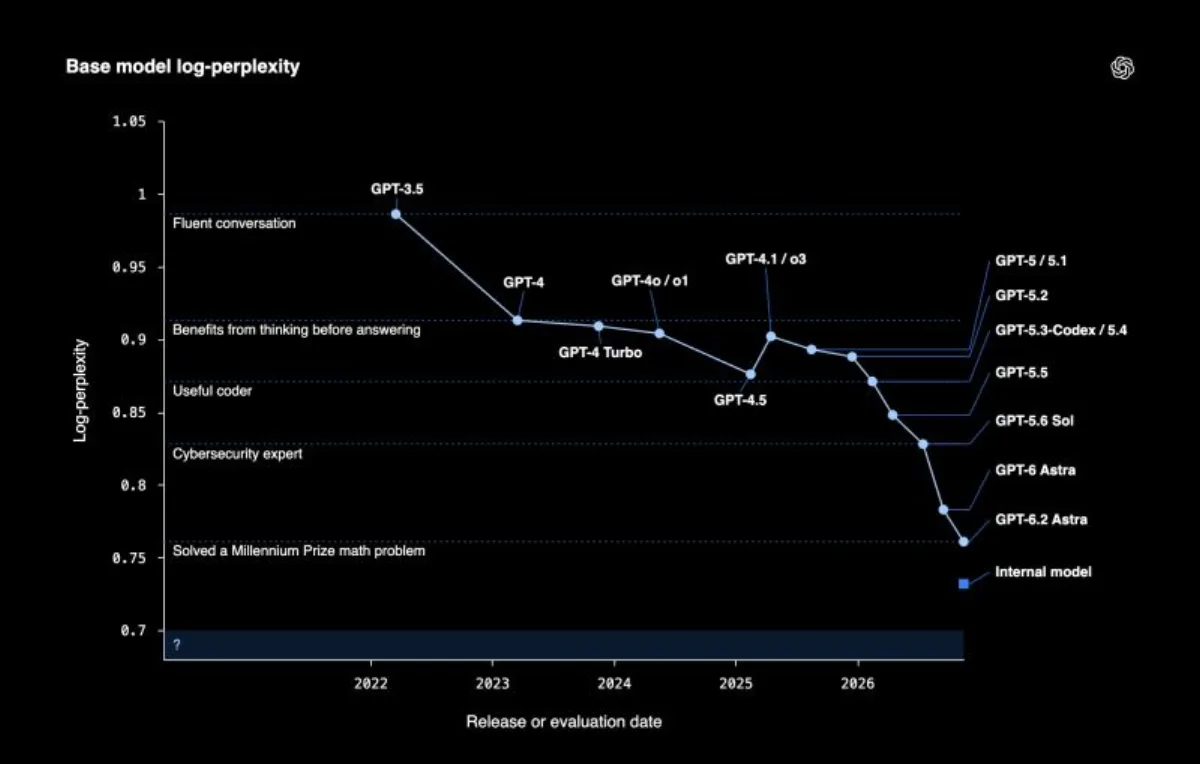
The proposal: frontier labs agree on a common perplexity limit, and do not cross it until a concrete safety milestone is met.
It is rare for a company to put competitively sensitive data on the table. Still, as an engineer, I have two questions.
The first is about measurement. These values come from OpenAI’s own dataset. Losses measured on different datasets cannot be compared. Without a shared held-out test set that no lab has trained on, the proposed limit stays an internal target of one company.
The second is about scope. The essay itself admits that gains from chain-of-thought reasoning do not lower perplexity. In my view, the same holds for search-based methods such as tree of thoughts, and for inference-time compute in general. A lab could keep pretraining at the limit and still raise capability at inference time.
Shannon’s quantity may make a good thermometer. To use it as a thermostat, everyone first has to measure in the same room.
Source: Perplexity and intelligence (OpenAI).