A university timetable can look clean on paper and still break in operation
One instructor booked in two rooms. One lab section with no valid slot. By week three, the schedule isn’t a plan anymore; it’s exception management.
This is why timetabling isn’t a spreadsheet task. It’s a constrained optimization problem — hundreds of sections and thousands of interacting rules, where one wrong placement quietly breaks ten others.
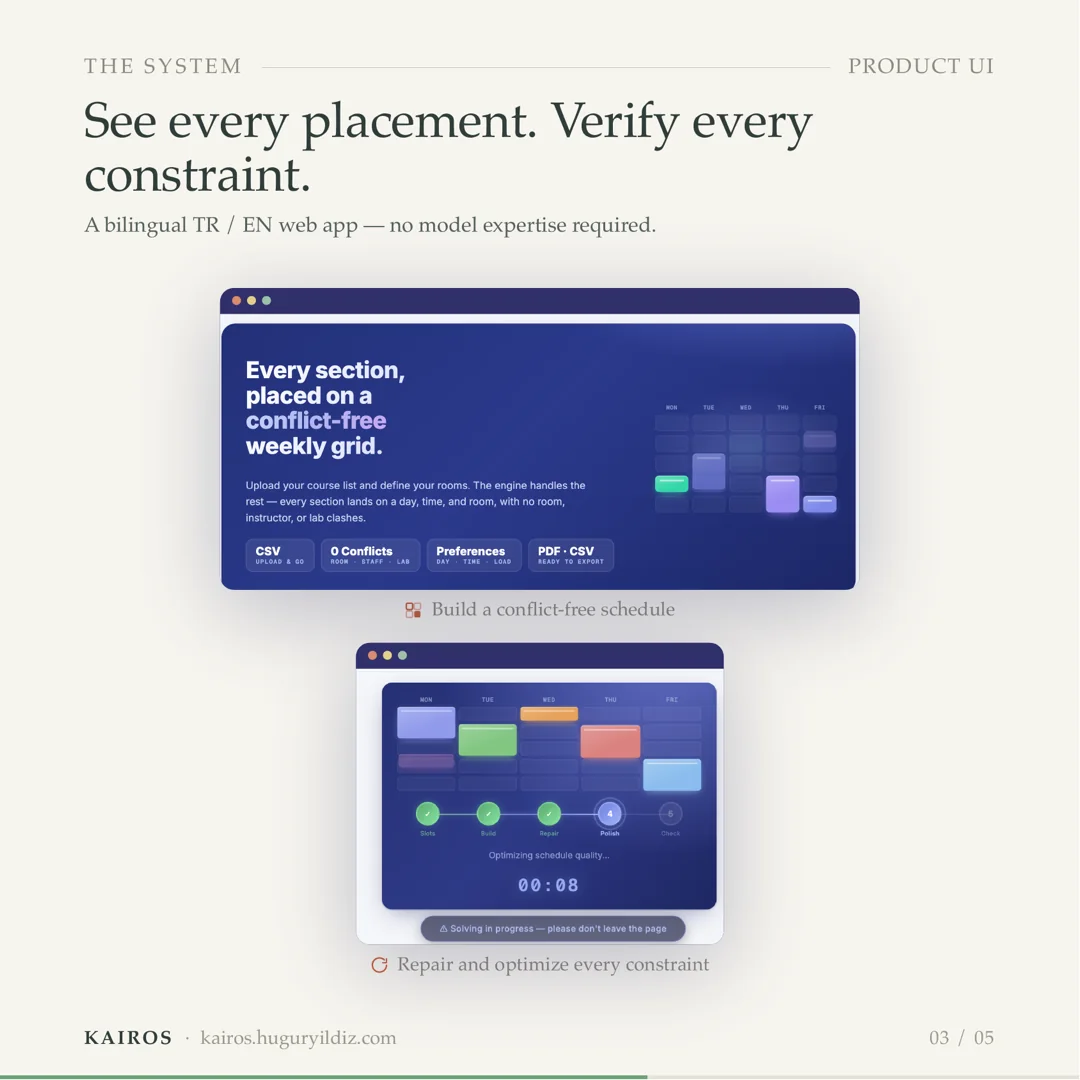
KAIROS is a university timetabling engine built on Google OR-Tools CP-SAT. It turns raw course, room, faculty, and policy data into a schedule that is feasible by construction, and independently verified.
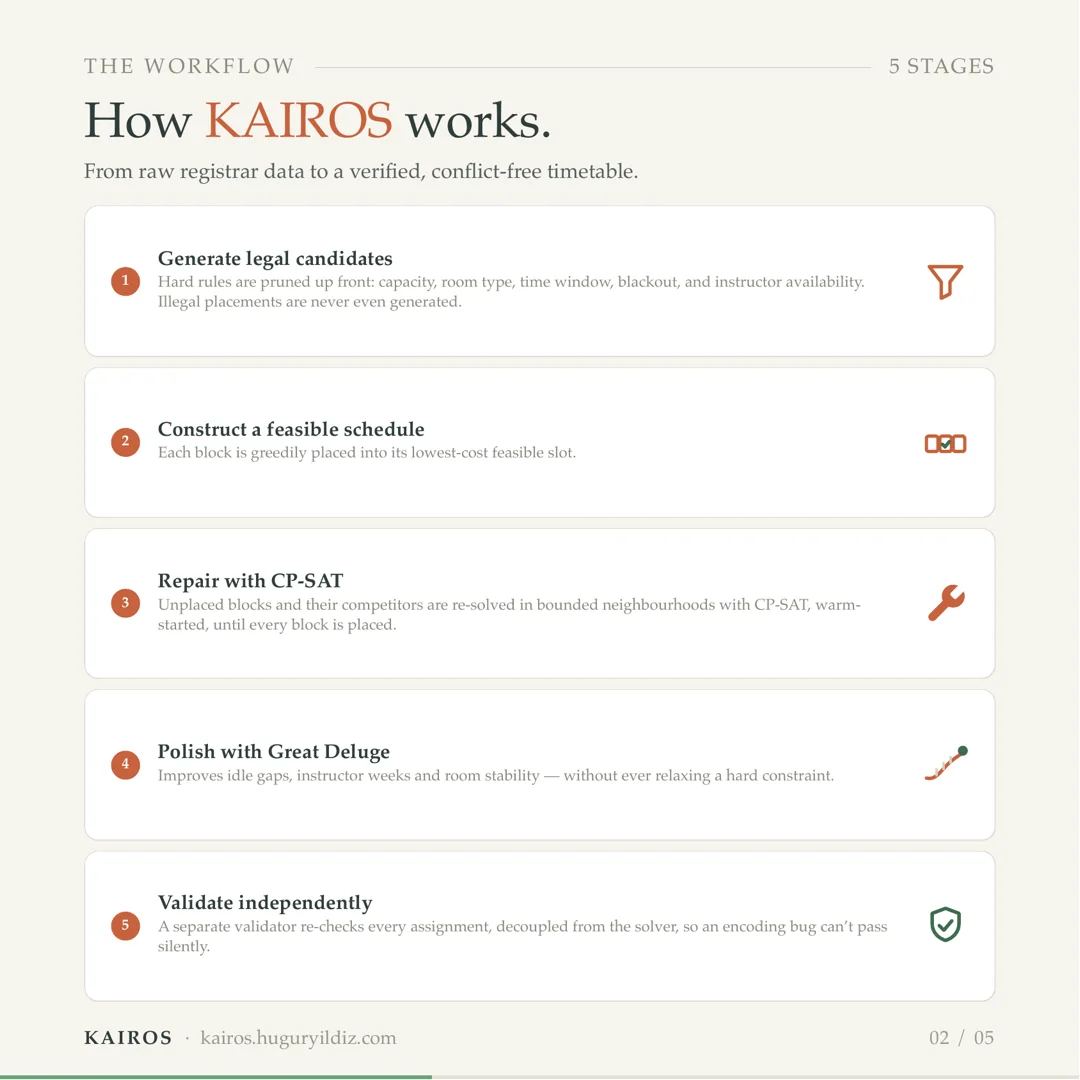
How it works — five stages
- Prune hard rules up front, so illegal placements never exist
- Construct a feasible schedule, block by block
- Repair with CP-SAT until every block is placed
- Polish with Great Deluge — never at the cost of a hard constraint
- Validate every assignment independently
A full university term solves in 3–10 minutes, depending on the quality target.
Results — two live terms
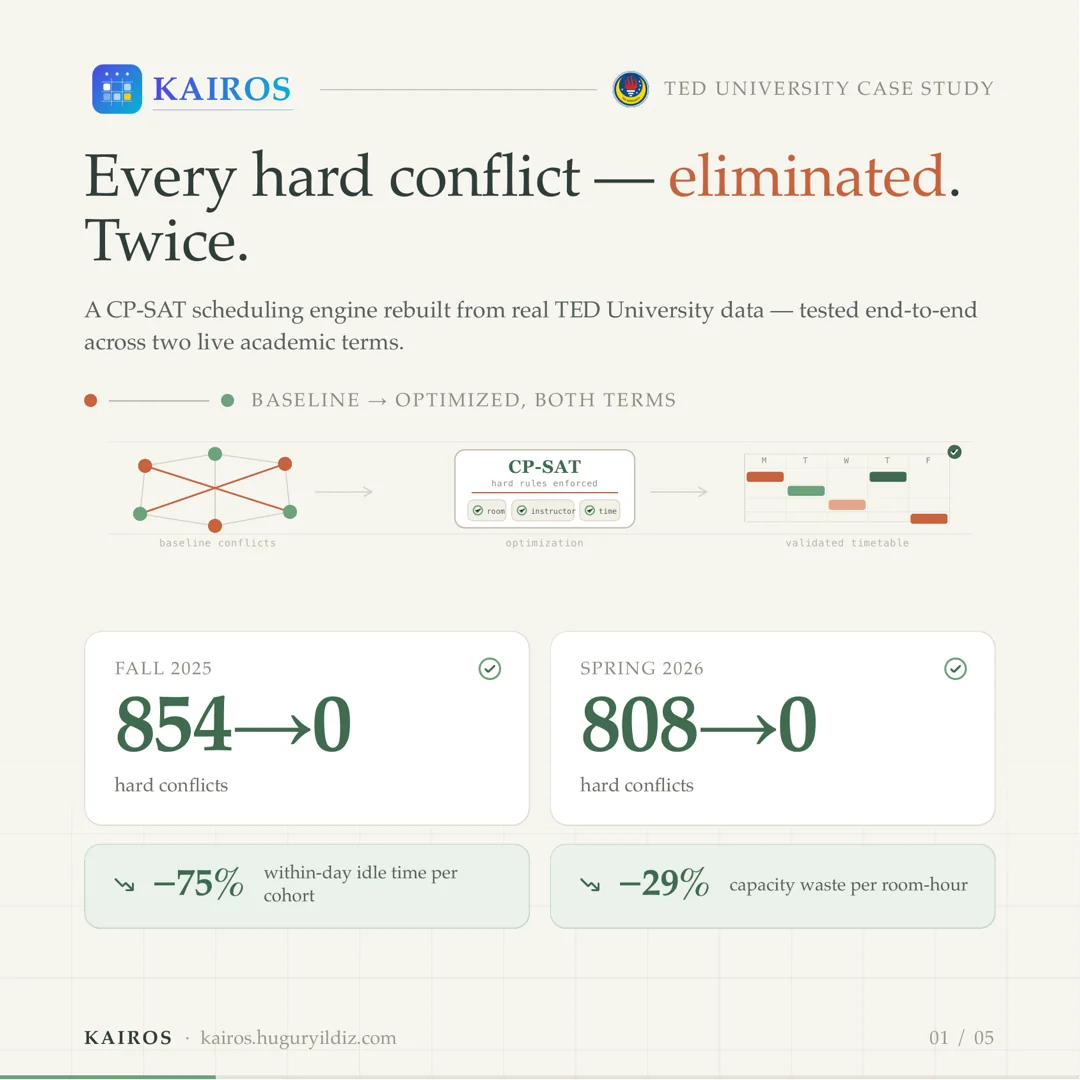
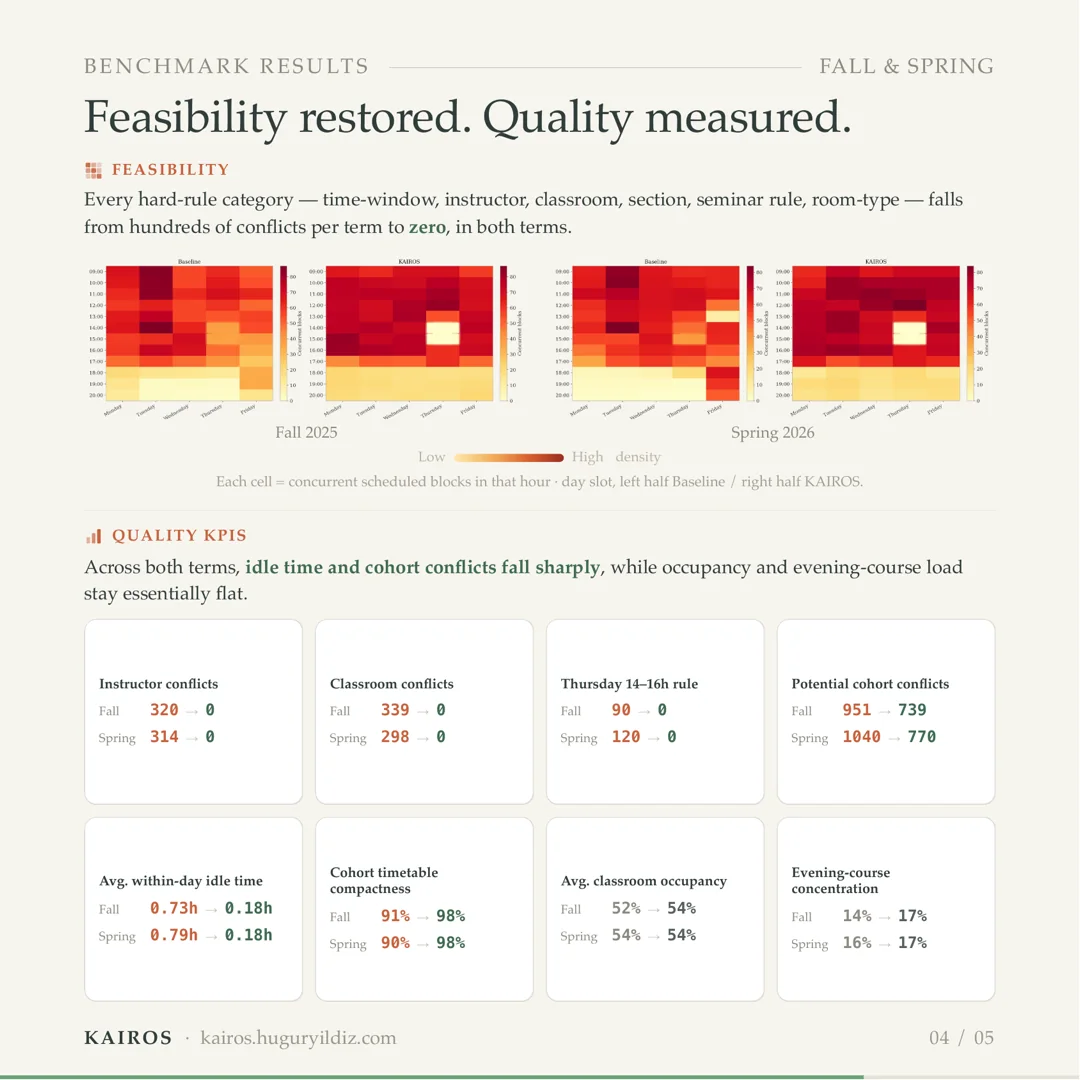
Tested on two live TED University terms (Fall 2025 and Spring 2026), KAIROS drove every tracked hard-constraint category to zero unresolved violations in both semesters. Within-day idle time dropped ~75% and capacity waste ~29% per room-hour, while occupancy and evening load stayed stable.
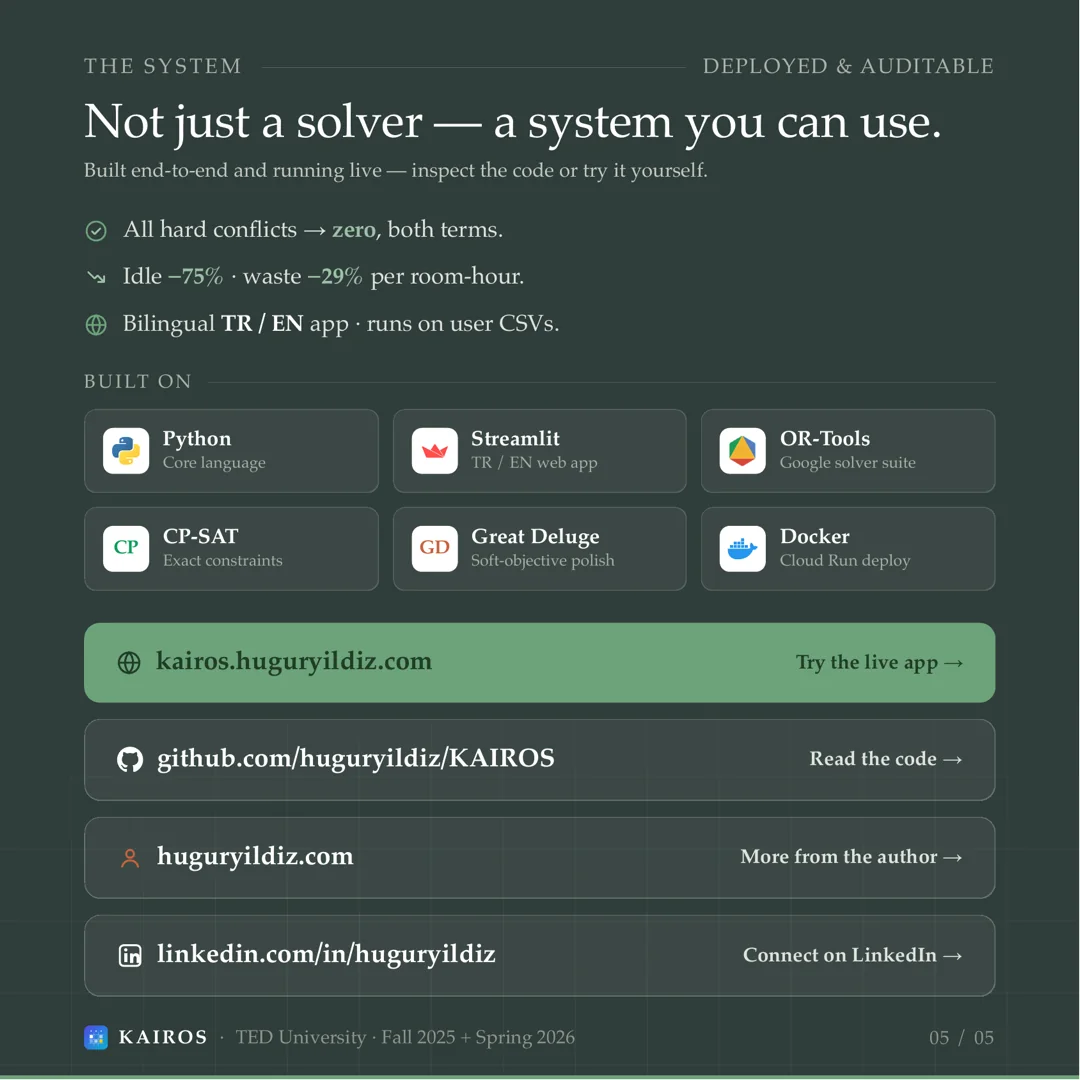
Swipe / scroll for the workflow, feasibility heatmaps, and term-by-term KPIs →
Scheduling that is transparent, reproducible, and operationally reliable.
Explore the system end-to-end:
For those who’ve run timetabling at scale: once feasibility is solved, which objective comes next — idle time, room use, or instructor workload balance?