The AI Layoff Trap
Falk and Tsoukalas’s recent paper begins with a simple question: if firms replace workers with AI, who will buy their products? A laid-off worker is also a customer; when income falls, spending falls too.
This is a classic prisoner’s dilemma. Each firm captures the full saving from automation while bearing only a small share of the demand loss it creates; the remaining harm is spread across competitors. A firm that does not automate loses market share. Even when firms would collectively lose, they cannot exit the race. The model says two things: the divergence grows as competition increases, and the problem becomes more severe as AI improves.
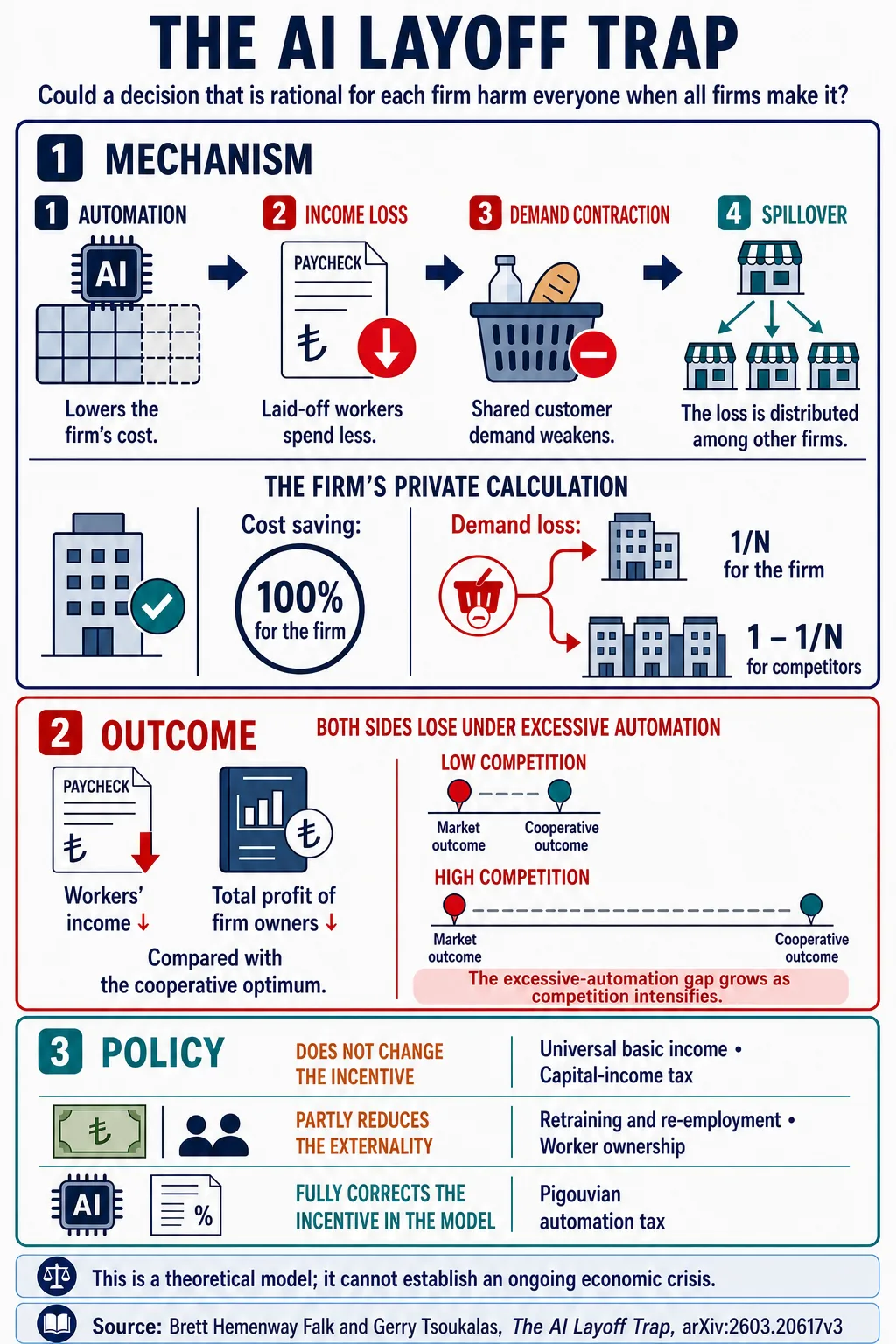
Universal basic income and capital-income taxes do not change the firm’s incentive. According to the authors, an automation tax is the only instrument that directly corrects it. The caveat matters: this is a theoretical model, not an empirical test; the mechanism weakens if new income sources emerge quickly.
Which sector would show this effect first?
Source: Brett Hemenway Falk and Gerry Tsoukalas, The AI Layoff Trap.