Hüseyin Uğur Yıldız

Teaching

Current courses at TED University

Undergraduate

EE 304 — Probability and Random Variables

A third-year undergraduate course covering probability models, discrete and continuous random variables, joint and conditional distributions, correlation, covariance, and expectation.

EE 311 — Signals and Systems

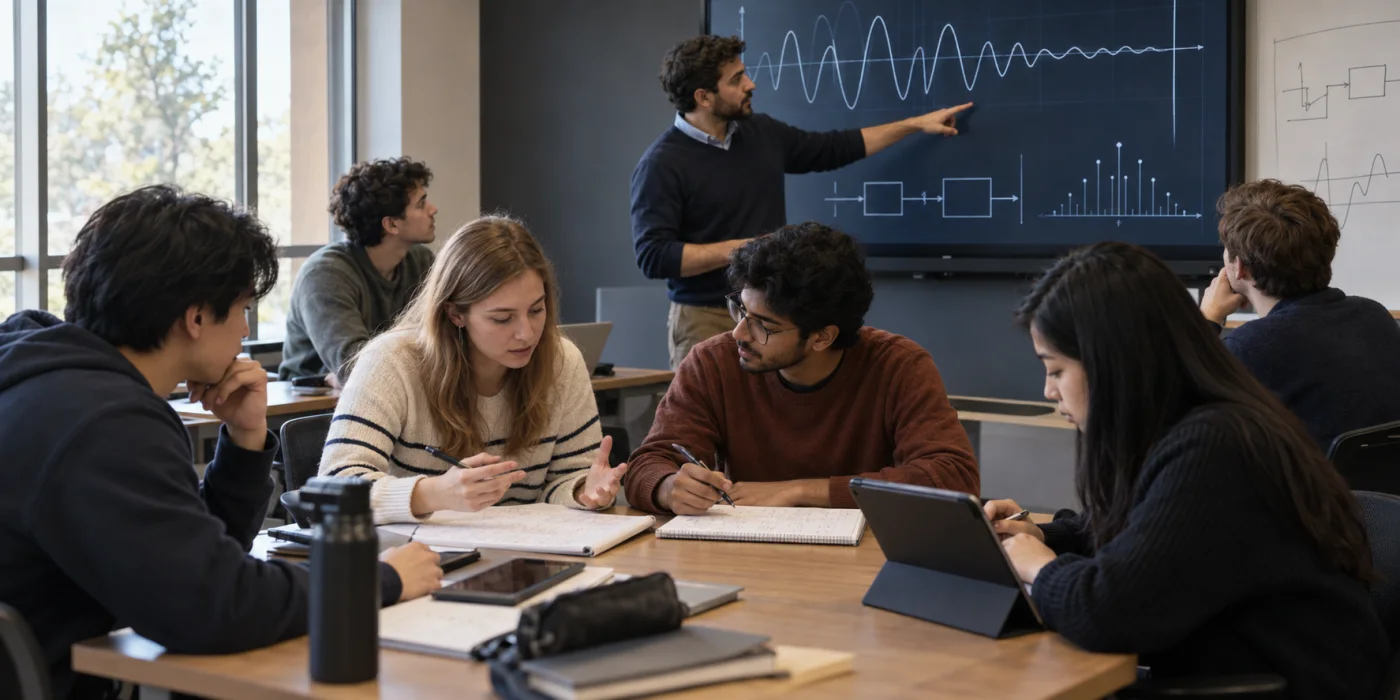
A third-year undergraduate course covering continuous-time and discrete-time signals, linear systems, Fourier analysis, and sampling theory.

EE 413 — Communication Systems II

A senior-level undergraduate course covering digital communication systems, sampling, quantization, digital modulation, receiver design, noise effects, and introductory information theory concepts.

EE 491 / EE 492 — Senior Design Project I & II

A two-semester capstone sequence focused on the design and implementation of an electrical and electronics engineering system, emphasizing engineering analysis, technical reporting, and teamwork.

Graduate

EE 512 — Optimization for Communication Networks

Graduate-level course covering optimization techniques for communication networks, including linear, integer, mixed-integer programming, network flows, and wireless network applications.

Previously taught courses at TED University

EE 205 — Software Tools for Electrical Engineering

A second-year undergraduate course introducing MATLAB-based software tools and computational methods for electrical engineering applications.

EE 312 — Communication Systems I

A third-year undergraduate course covering communication systems, modulation techniques, and noise analysis.

EE 462 — Power System Analysis

A senior-level undergraduate course covering power system modeling, load flow, fault analysis, smart grids, and renewables.

Course materials, including lecture notes and supplementary resources, are available through the TEDU LMS.

Teaching philosophy and pedagogical approach

My teaching philosophy integrates theory, practice, and active learning to foster independent thinking and lifelong learning. I emphasize:

My goal is to create an engaging and supportive learning environment that helps students develop strong analytical and problem-solving skills.